The commercial cleaning industry is entering a new era.
For decades, cleaning companies competed on labor, price, relationships, and reputation. Those things still matter, but they are no longer enough. Labor is harder to find. Wages are rising. Insurance is expensive. Customers want proof that work was completed. Buildings are being used differently because of hybrid schedules. Margins are getting tighter.
That means the next major advantage in commercial cleaning will not belong to the company with the lowest bid.
It will belong to the company that can combine people, robots, sensors, automation, and data into a smarter operating system.
The new moat in commercial cleaning is not simply owning technology.
The new moat is building a business where technology does the repetitive work, automation handles the routine management, robots clean while people are off-site or home, and human workers move into better, safer, higher-value roles.
Robots Are Not the Future. They Are the New Baseline.
Robotic floor scrubbers, autonomous vacuums, smart restroom systems, IoT sensors, digital inspection platforms, GPS-enabled workforce tools, and AI scheduling systems are no longer science fiction. They are becoming the equipment layer of the modern cleaning company.
But buying a robot does not create a competitive advantage by itself.
Any company can buy a machine.
The advantage comes from knowing how to deploy it, train workers around it, measure the results, and use the data to run a better business.
A robot that sits unused in a closet is not innovation. It is wasted capital.
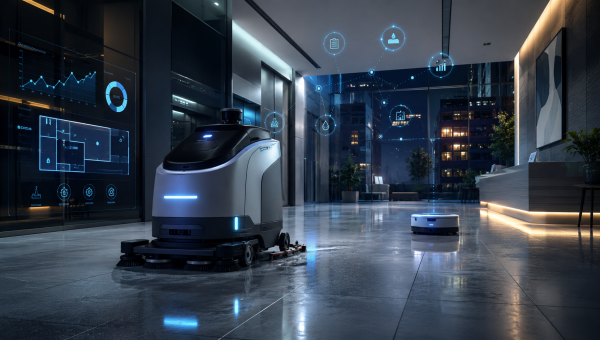
A robot that cleans 50,000 square feet overnight while the team is home, then reports completion data before the morning shift begins, is a completely different business model.
The Real Breakthrough: Cleaning While Workers Are Home
One of the biggest shifts coming to commercial cleaning is autonomous overnight and off-hour cleaning.
Imagine a facility where robotic scrubbers, vacuums, and automated systems handle repetitive floor care after hours. The equipment follows mapped routes, avoids obstacles, tracks completed areas, and reports performance data back to management.
Human workers do not disappear. They become more valuable.
Instead of spending every hour pushing machines, they can focus on detail cleaning, touchpoints, restrooms, inspections, maintenance, customer service, quality control, and machine setup.
In some cases, workers may be able to manage larger facilities with fewer physically demanding hours on-site. Supervisors may review reports remotely. Managers may know before sunrise whether the job was completed, where a machine stopped, what areas were missed, and what needs attention.
That is a massive shift.
The company is no longer selling labor hours.
It is selling verified cleaning performance.
Automation Protects Workers, Not Just Profits
The commercial cleaning workforce is aging. The work is physically demanding. Repetitive pushing, bending, lifting, and walking across large facilities takes a toll.
Robots and automation should not be framed only as cost-cutting tools. That is too small of a vision.
They should be framed as workforce protection.
Robots can reduce strain. Automation can reduce repetitive tasks. Smart systems can make schedules more realistic. Digital inspections can help teams catch issues before customers complain. Better tools can make cleaning jobs more sustainable for older workers and more attractive to younger workers.
The best cleaning companies will not use technology to erase people.
They will use technology to keep good people longer.
Data Becomes the New Proof of Clean
For years, cleaning companies told customers the work was done.
Now customers want evidence.
The future of commercial cleaning will be built around proof: digital logs, inspection reports, robot cleaning maps, restroom traffic data, response times, quality scores, and before-and-after documentation.
This changes the sales conversation.
A traditional cleaning company says, “We clean your building five nights a week.”
A modern cleaning company says, “Here is exactly what was cleaned, when it was cleaned, how long it took, what was inspected, what issues were found, what was corrected, and how your facility is trending over time.”
That is not just cleaning.
That is facility intelligence.
The Company With the Best System Wins
The next great commercial cleaning companies will not be built only around crews and contracts. They will be built around systems.
A true technology moat includes:
Robots that handle repetitive production work.
Sensors that show where cleaning is needed most.
Automation that schedules work based on real facility usage.
AI that helps estimate labor, pricing, inspections, and risk.
Dashboards that prove performance to customers.
Training programs that turn cleaners into technology-enabled operators.
Management systems that know what is happening before the customer complains.
That is the new competitive advantage.
Not the robot.
Not the software.
Not the sensor.
The moat is the complete system working together.
The Human Role Gets Smarter
There is a fear that robots will replace cleaning workers. Some jobs will change. Some tasks will be automated. That is real.
But the better opportunity is to redesign cleaning work so humans are not trapped doing the hardest repetitive tasks forever.
The future cleaner may also be a machine operator, quality inspector, customer service representative, safety observer, supply manager, and building data reporter.
That creates room for better training, better pay, better career paths, and better retention.
The companies that understand this will attract better workers.
The companies that do not will keep fighting the same labor shortage year after year.
The New Moat Is Autonomous Cleaning Operations
Technology is not the moat.
Autonomous cleaning operations are the moat.
A company that can send robots into a building after hours, track every completed zone, alert supervisors to problems, reduce physical strain on workers, produce reports for customers, and continuously improve its schedules has a business advantage that is hard to copy.
That company is not just cleaning buildings.
It is running a data-driven cleaning network.
That is where the industry is heading.
The commercial cleaning companies that win the next decade will be the ones that stop thinking of technology as a gadget and start thinking of it as the operating system of the entire business.
Robots clean.
Automation manages.
Data proves.
Workers supervise, improve, inspect, and build relationships.
That is the future of commercial cleaning.
And that is the real new moat.